
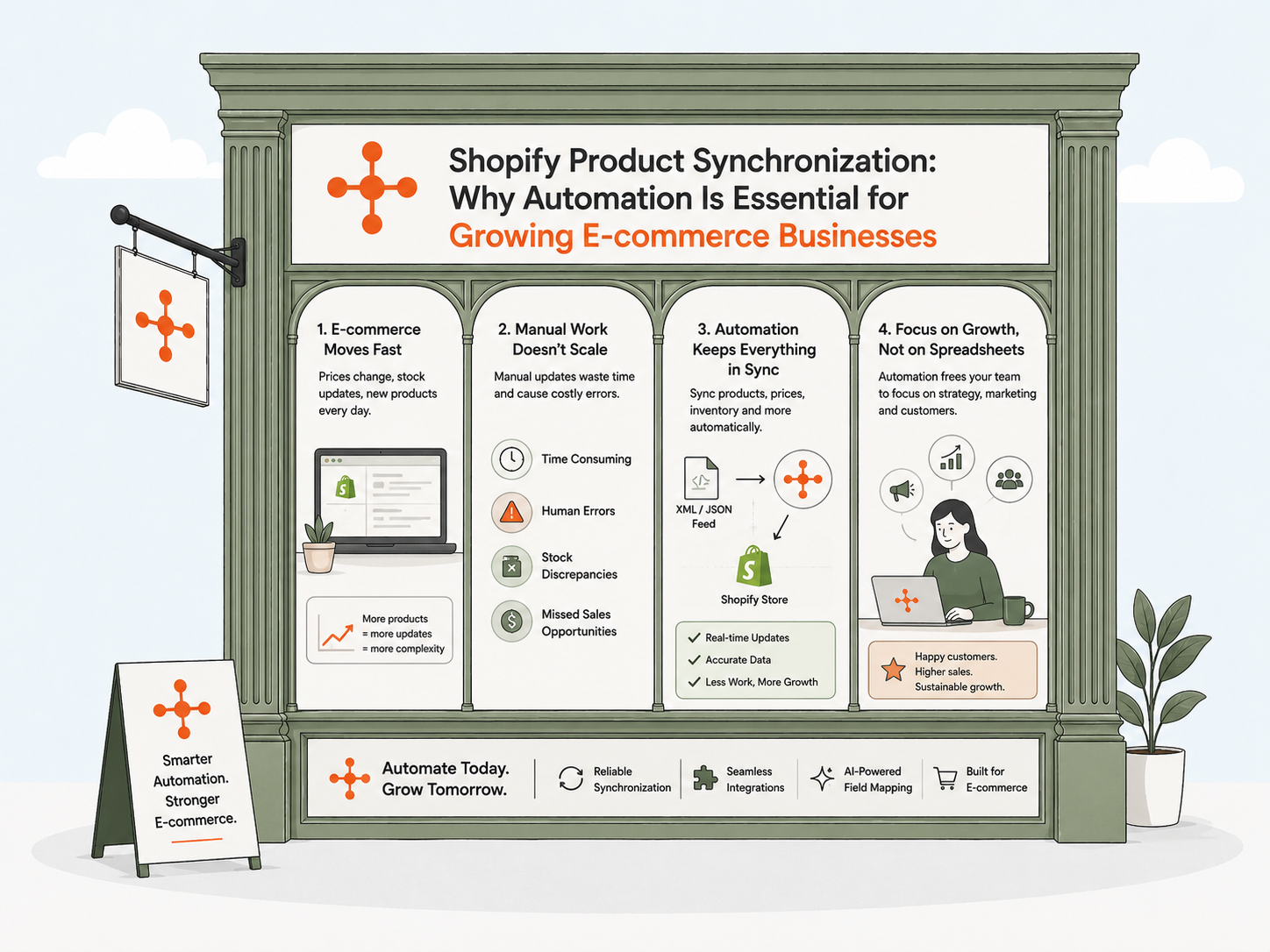
Running a successful Shopify store is no longer just about having great products. Modern e-commerce businesses must also manage thousands of product updates, inventory changes, pricing adjustments, images, categories, and supplier feeds—all while providing an excellent customer experience.
For many merchants, this quickly becomes one of the biggest operational challenges.
Updating products manually may work when you have 20 products. It becomes nearly impossible when your catalog grows to hundreds or thousands of SKUs.
This is why Shopify Product Synchronization has become an essential part of modern e-commerce operations.
With WeblioHub, businesses can automatically synchronize products using XML or JSON feeds, intelligently map supplier data using artificial intelligence, and ensure that their Shopify store always displays accurate, up-to-date information.
What Is Shopify Product Synchronization?
Shopify Product Synchronization is the process of automatically transferring and updating product information between your data source and your Shopify store.
Instead of manually editing products, synchronization ensures that every important change—whether it’s a price update, stock adjustment, new product image, or product description—is reflected automatically.
Think of it as a bridge between your supplier and your Shopify store.
Whenever your supplier updates their catalog, your Shopify store updates automatically.
No spreadsheets.
No manual imports.
No repetitive work.
Why Product Synchronization Matters More Than Ever
Global e-commerce continues to grow every year.
At the same time, product catalogs are becoming larger and more dynamic.
Manufacturers update:
- Prices
- Stock quantities
- Images
- Product descriptions
- Product specifications
- Categories
- Variants
Sometimes multiple times every day.
If your Shopify store doesn’t stay synchronized, customers may see outdated information.
This can lead to:
- Incorrect pricing
- Overselling products
- Lost sales
- Customer complaints
- Poor user experience
Automation eliminates these risks.
The Hidden Cost of Manual Product Management
Many merchants underestimate how much time they spend managing products.
Imagine updating:
- 500 products
- 5,000 products
- 50,000 products
Even a small price adjustment can require hours of work.
Manual product management often creates:
Human Errors
Typing mistakes happen.
Automation doesn’t get tired.
Outdated Inventory
Nothing frustrates customers more than ordering an unavailable product.
Real-time synchronization helps maintain accurate inventory information.
Lost Revenue
Incorrect prices and outdated product information directly affect sales.
Keeping products synchronized protects revenue.
Reduced Productivity
Your team should spend time growing the business—not copying product information between systems.
XML and JSON: The Industry Standard
Almost every supplier, wholesaler, dropshipping platform, and ERP system distributes product data using XML or JSON.
These formats have become the global standard for exchanging product information.
XML feeds are widely used by:
- Manufacturers
- Wholesale suppliers
- Marketplace integrations
- ERP systems
JSON feeds are commonly provided through:
- APIs
- Modern SaaS platforms
- Headless commerce solutions
- Custom inventory systems
WeblioHub supports both.
Simply connect your feed URL and let the platform handle the rest.
AI-Powered Field Mapping
One of the most frustrating parts of product synchronization is field mapping.
Every supplier uses different naming conventions.
For example:
Supplier A:
- ProductTitle
Supplier B:
- Product_Name
Supplier C:
- ItemName
All of these represent the same Shopify field:
Title
Normally, merchants must manually configure every field.
WeblioHub eliminates this process.
Its AI analyzes your XML or JSON feed and automatically recommends the correct Shopify fields.
This reduces setup time dramatically while minimizing mapping errors.
Intelligent Product Synchronization
WeblioHub doesn’t simply import products once.
It continuously monitors your connected feed and synchronizes changes automatically.
Updates can include:
- Product names
- Descriptions
- Prices
- Compare-at prices
- Stock quantities
- Images
- Categories
- Vendors
- Variants
- Tags
- SKUs
- Barcodes
This ensures your Shopify catalog always reflects the latest supplier information.
Faster Store Growth Through Automation
Successful businesses automate repetitive tasks.
Instead of spending hours managing products, merchants can focus on:
- Marketing campaigns
- SEO
- Customer service
- Product strategy
- Business expansion
Automation transforms product management from a daily task into a background process.
Built Specifically for Shopify
Unlike generic import software, WeblioHub is designed specifically for Shopify.
Installation is simple.
After installing the WeblioHub app, merchants can:
- Connect XML feeds
- Connect JSON feeds
- Configure synchronization settings
- Review AI field suggestions
- Start automatic product synchronization
Everything happens from one intuitive dashboard.
No technical expertise required.
More Than Product Synchronization
While Shopify Product Sync is one of WeblioHub’s core features, the platform also provides additional tools designed to improve customer engagement and simplify store management.
With WeblioHub, merchants can also use:
🤖 AI Chatbot
Answer customer questions automatically, guide shoppers through products, and provide 24/7 support.
🍪 Cookie Consent & Analytics
Manage privacy compliance while gaining valuable visitor insights from a unified dashboard.
📄 Shopify Pages Synchronization
Keep important pages synchronized alongside your products.
📩 Contact Forms
Collect customer inquiries directly from your website.
⭐ Product Reviews
Build trust with authentic customer feedback.
By combining these tools into one platform, WeblioHub helps merchants reduce the number of apps they rely on and simplify daily operations.
Why Businesses Around the World Choose Automation
Across global e-commerce markets, automation is no longer a competitive advantage—it is an operational necessity.
Businesses using automated synchronization benefit from:
- Faster product updates
- Fewer manual errors
- Lower operational costs
- Better customer experience
- Improved inventory accuracy
- Increased scalability
Whether your catalog contains hundreds or hundreds of thousands of products, automation allows your business to grow without increasing administrative workload.
Why Choose WeblioHub?
WeblioHub combines modern automation with artificial intelligence to create one of the easiest product synchronization solutions available for Shopify.
Key Features
✅ XML Product Import
✅ JSON Product Import
✅ AI-Powered Field Mapping
✅ Automatic Product Synchronization
✅ Shopify Native App
✅ Lightweight Infrastructure
✅ Fast Installation
✅ No Coding Required
✅ Secure Cloud-Based Platform
✅ Easy Dashboard Management
Whether you’re importing products from a local supplier or synchronizing a global catalog, WeblioHub provides the flexibility and automation needed to keep your store running efficiently.
Future-Proof Your Shopify Store
The future of e-commerce belongs to businesses that automate repetitive processes.
Manual product management slows growth, increases costs, and creates unnecessary complexity.
By implementing automated synchronization with WeblioHub, merchants gain a smarter workflow that keeps product data accurate, improves operational efficiency, and frees valuable time for business growth.
Instead of managing product updates, focus on building your brand, serving your customers, and expanding your business.
Start Synchronizing Smarter with WeblioHub
Whether you’re a small Shopify merchant or an enterprise managing thousands of products, WeblioHub makes product synchronization simple.
Connect your XML or JSON feed once, let AI handle field mapping, and enjoy automatic synchronization that keeps your Shopify catalog accurate every day.
Less manual work. More automation. Better e-commerce.