A website visitor starts a conversation.
They ask a few questions about your product or service.
The AI chatbot provides the information they need.
Then comes the most important moment:
“I would like to have a meeting with you.”
Traditionally, this is where the conversation leaves the website.
You send the visitor to a contact form, share a scheduling link, ask them to send an email, or wait for your sales team to follow up.
Every additional step creates friction.
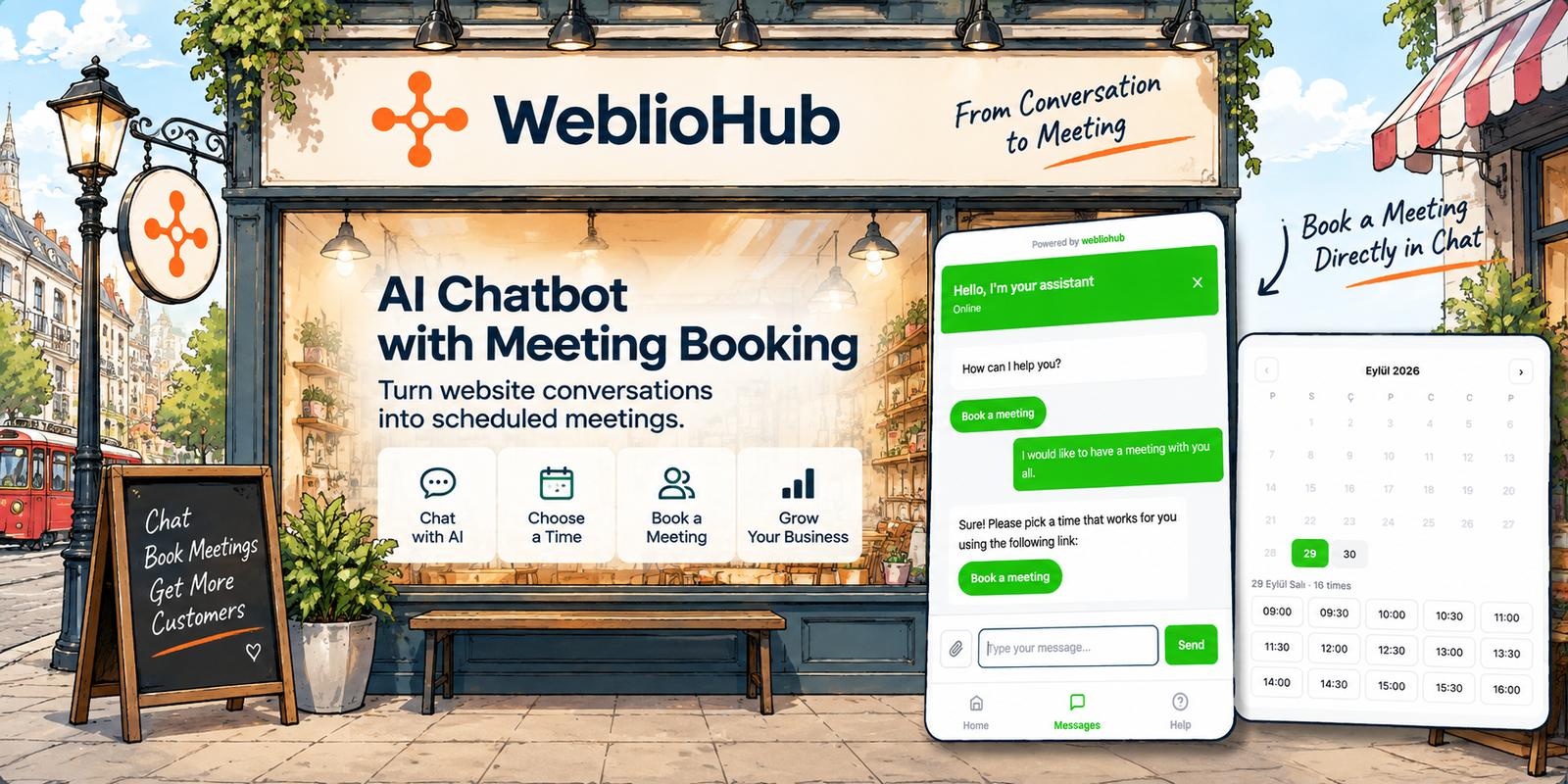
With WeblioHub’s AI Chatbot Meeting Booking, visitors can move directly from a conversation to scheduling a meeting — without leaving the chatbot experience.
Ask → Chat → Choose a Time → Book a Meeting.
One continuous customer journey.
Introducing Meeting Booking Inside WeblioHub AI Chatbot
WeblioHub AI Chatbot can now help visitors schedule meetings directly during a conversation.
When a visitor indicates that they want to arrange a meeting, the chatbot can present a Book a Meeting action.
The visitor opens the scheduling interface, selects an available date and chooses a suitable time.
The process happens as a natural extension of the conversation.
Instead of:
Conversation → External Page → Form → Email → Follow-up
the experience becomes:
Conversation → Available Times → Meeting
This seemingly small difference can create a much smoother path from customer interest to an actual business conversation.
How AI Chatbot Meeting Booking Works
The workflow is intentionally simple.
1. A Visitor Starts a Conversation
A potential customer arrives on your website and opens the WeblioHub AI Chatbot.
They can ask normal questions about your company, services or products.
For example:
“Can you explain your service?”
“Do you support Shopify?”
“Can this work for my business?”
The AI chatbot can handle the initial conversation and help the visitor find the information they need.
2. The Visitor Wants to Speak with You
At some point, the visitor may want to continue the conversation with a real person.
They might say:
“Can we schedule a meeting?”
“I’d like to speak with your team.”
“Can I book a demo?”
Instead of ending the automated conversation, WeblioHub can move the visitor directly toward scheduling.
3. The Chatbot Offers Meeting Booking
A Book a Meeting option can appear directly inside the conversation.
The visitor doesn’t need to search your website for a contact page or manually copy a scheduling URL.
The next action is immediately available.
4. The Visitor Chooses a Date
The scheduling interface displays the available dates.
Visitors can browse the calendar and select the day that works for them.
5. They Select an Available Time
Once a date is selected, available meeting times are displayed.
For example:
09:00 · 09:30 · 10:00 · 10:30 · 11:00
The visitor simply chooses a suitable slot.
The entire experience remains connected to the chatbot interaction.
From AI Conversation to Real Business Opportunity
AI chatbots are often discussed primarily as customer-support tools.
But their role can go much further.
A good chatbot shouldn’t only answer questions.
It should help visitors take the next logical action.
For an e-commerce store, that might mean discovering a product.
For customer support, it might mean solving a problem.
For a B2B company, agency, SaaS platform or service business, that next action may be:
Booking a meeting.
This changes the role of the chatbot.
Instead of being only:
Question → Answer
it can become:
Question → Answer → Intent → Action
And that final step is particularly important.
Why Booking Meetings Inside the Chat Matters
Imagine a visitor has spent several minutes speaking with your AI chatbot.
They already understand your product.
Their questions have been answered.
They’re interested enough to speak with your company.
This is a high-intent moment.
Sending them somewhere else introduces another decision.
“Open this scheduling page.”
“Fill out this form.”
“Send us an email.”
“We’ll contact you later.”
Some users will continue.
Others won’t.
Providing the booking action directly when the visitor expresses intent reduces unnecessary steps between interest and conversion.
Your AI Chatbot Becomes More Than Customer Support
The traditional perception of chatbots is straightforward:
Customer asks something → chatbot answers.
AI allows us to build a much broader interaction model.
A WeblioHub chatbot can assist a visitor during their journey and then provide relevant actions.
For example:
Visitor:
“What does WeblioHub do?”
AI:
Explains the platform.
Visitor:
“Can I use this with my Shopify store?”
AI:
Explains the Shopify integration.
Visitor:
“I’d like to discuss this with someone.”
AI:
“Sure! Please pick a time that works for you.”
[ Book a Meeting ]
The visitor can then choose a date and time.
That is a significantly more useful interaction than simply answering the final question with “Contact our sales team.”
AI Chatbot + Appointment Scheduling
Combining conversational AI with scheduling connects two traditionally separate parts of the customer journey.
The AI chatbot handles discovery and questions.
The meeting scheduler handles conversion to a human conversation.
Together, they create a continuous workflow:
Discover
↓
Ask
↓
Understand
↓
Show Intent
↓
Schedule
↓
Meet
This is particularly useful for businesses where a conversation is an important part of the sales process.
Who Can Use AI Meeting Booking?
The feature can be useful across many types of businesses.
SaaS companies can allow potential customers to schedule product demos.
Digital agencies can turn project inquiries into consultation meetings.
Consultants can allow qualified prospects to select an available consultation time.
B2B companies can move interested website visitors toward sales conversations.
Service businesses can provide an easier appointment-booking experience.
Shopify merchants with higher-value or complex products can offer customers a way to speak with someone before purchasing.
The common factor is simple:
When a website conversation can lead to a meeting, reducing friction matters.
Available 24/7, Even When Your Team Isn’t
Another advantage comes from combining scheduling with AI availability.
A visitor might discover your website at 11:30 PM.
Your sales team isn’t online.
But the visitor can still:
ask questions,
understand your service,
interact with the AI assistant,
and schedule an available meeting.
Your website doesn’t have to wait until the next business day to capture that intent.
The AI handles the conversation.
The scheduling system handles availability.
Your team handles the actual meeting.
Reduce the Gap Between Support and Sales
Website interactions aren’t always clearly divided into “support” and “sales.”
A visitor might begin with a technical question and eventually become interested in buying.
Someone might ask:
“Does your product support XML feeds?”
Then:
“Can it synchronize 20,000 products?”
Then:
“Could we discuss our setup with your team?”
The conversation has naturally moved from product information to sales intent.
An intelligent chatbot experience should be able to support that transition.
Meeting booking provides the bridge.
No More “We’ll Get Back to You”
Traditional lead generation often works asynchronously.
A visitor completes a form.
Your company receives it.
Someone reviews the submission.
Your team sends an email.
The customer replies.
Both sides try to find a suitable time.
That process can take hours or days.
Scheduling directly during the original conversation removes several of those steps.
The visitor is already there.
Their intent is already clear.
Give them the opportunity to act on it.
One Chatbot, Multiple Business Actions
Meeting booking also represents a broader direction for WeblioHub AI Chatbot.
The chatbot doesn’t have to remain a passive question-and-answer interface.
It can become an action-oriented layer between your website and your customers.
Depending on the conversation, visitors can receive information, discover products, interact with your business and now schedule meetings.
The objective is not simply to make AI generate better answers.
It’s to make AI conversations more useful for the business and the customer.
Turn Conversations into Meetings with WeblioHub
Every website conversation represents intent.
Sometimes the visitor simply needs an answer.
Sometimes they need support.
And sometimes they’re ready to talk to your business.
WeblioHub AI Chatbot can now help bridge that final gap.
Visitors can start with a simple question, interact naturally with AI, request a meeting, choose an available date and select a suitable time — all as part of the same customer journey.
No unnecessary back-and-forth.
No searching for the right contact page.
No waiting for someone to send a scheduling link.
Chat. Choose a time. Meet.
That’s the idea behind meeting booking in WeblioHub AI Chatbot.
FAQ
Can visitors book a meeting directly from the WeblioHub chatbot?
Yes. The meeting-booking experience can be presented as part of the chatbot flow, allowing the visitor to move from conversation to scheduling.
Can visitors choose their own meeting time?
The scheduling interface shows available dates and time slots so the visitor can select an appropriate option.
Can AI suggest booking a meeting during a conversation?
The meeting-booking action can be incorporated into the conversational experience when a visitor wants to schedule a meeting.
Is this useful for lead generation?
It can be particularly useful for businesses where website conversations frequently lead to demos, consultations, sales calls or other meetings.
Does the visitor have to stop chatting to schedule?
The key benefit of the feature is that scheduling is integrated into the chatbot journey rather than functioning as an unrelated contact process.